Clay Pot Irrigation: Ancient Water-Saving Magic
What if you could cut your garden watering by 70% using nothing but a clay pot and a little soil? Clay pot irrigation is one of the oldest, most effective watering methods ever discovered – and most modern gardeners have never heard of it. Rooted in ancient Persian tradition over 4,000 years ago, this buried-pot technique delivers water slowly and directly to plant roots, exactly where it’s needed most.
No timers. No hoses. No guesswork. Just ancient wisdom doing quiet, steady work underground.
If you’re tired of wilting plants, wasted water, and the endless chore of irrigation, this forgotten technique might be exactly what your garden needs.
What Is Clay Pot Irrigation?
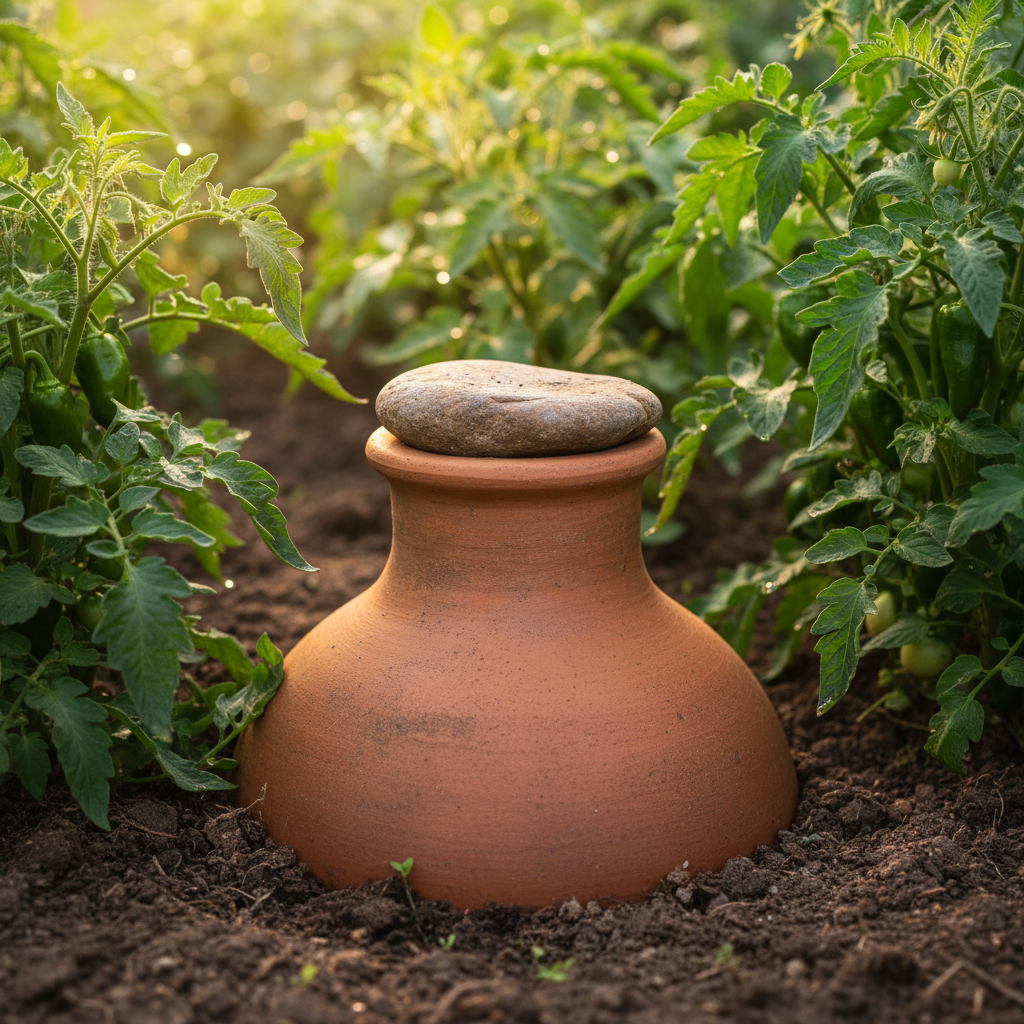
Clay pot irrigation – also called olla irrigation (from the Spanish word for pot) – involves burying an unglazed clay vessel in the soil near your plants. You fill it with water through a small opening at the top, then cap it to prevent evaporation.
Here’s where the magic happens. Unglazed clay is naturally porous. Water seeps slowly through the walls of the pot, drawn outward by the surrounding soil moisture. Plants take what they need, when they need it. The soil acts as a living sensor – pulling more water as it dries, slowing intake when it’s already moist.
This is passive, plant-driven irrigation at its finest. And it has been quietly feeding gardens across Persia, China, India, and the Americas for millennia.
Why Clay Pot Irrigation Outperforms Modern Sprinklers
Modern surface watering has a dirty secret: up to 50-70% of the water you apply never reaches plant roots. It evaporates off hot soil, runs off compacted ground, or gets absorbed by surface weeds before roots even sense it.
Clay pot irrigation eliminates almost all of that waste. Because water is released underground, directly into the root zone, there is virtually no surface evaporation. Studies from the University of California and international agricultural researchers have shown that olla irrigation can reduce water use by 50-70% compared to conventional surface irrigation.
That’s not a small improvement. That’s a transformation.
Beyond water savings, buried clay pots also:
- Discourage surface weeds (the topsoil stays drier)
- Reduce fungal disease risk (no wet foliage or surface splash)
- Encourage deep root growth (roots chase the moisture downward)
- Require far less daily attention than drip systems or hand watering
If you’ve been learning how your garden’s unique conditions affect growth, pair this technique with the insights from Mapping Your Garden Microclimates: Turn Sun, Wind, and Shade into Higher Yields. Understanding where heat and wind are strongest helps you place your ollas for maximum effect.
How to Set Up Your Own Clay Pot Irrigation System
The beautiful thing about this method is its simplicity. You don’t need electricity, plumbing expertise, or expensive equipment. Here’s exactly how to get started.
Step 1: Choose the Right Clay Pot
Look for unglazed terracotta pots or purpose-made olla vessels. The key word is unglazed. Glazed pottery seals the surface and prevents water from seeping through – it won’t work.
Traditional ollas are bulb-shaped with a narrow neck. However, standard terracotta pots work well too. Common sizes range from 1-quart pots for small containers to 2-gallon vessels for larger garden beds. The bigger the pot, the less frequently you’ll need to refill it.
Step 2: Seal the Drainage Hole
If you’re using a standard terracotta pot, plug the drainage hole at the bottom. A small cork, a dab of non-toxic sealant, or even a fired clay disk works perfectly. You want water to seep through the walls – not drain straight out the bottom.
Step 3: Bury It in Your Garden
Dig a hole deep enough to bury the pot almost entirely, leaving just the neck and rim above the soil surface. Position it close to your plants – ideally 6 to 12 inches from the root zone, depending on pot size and plant spread.
For raised beds or intensive plantings, one medium-sized olla can serve a cluster of 2-4 plants. Space additional pots every 18-24 inches in larger beds.
Step 4: Fill and Cap
Fill your buried clay pot with water and cover the opening with a flat stone, a terracotta saucer, or a fitted lid. This prevents mosquitoes from breeding and stops surface evaporation from the pot’s opening.
Refilling frequency depends on your climate, soil type, and plant thirst. In hot, dry conditions, you might refill every 2-3 days. In cooler or humid weather, once a week may be enough. You’ll quickly develop a feel for your garden’s rhythm.
Step 5: Add a Little Organic Boost
Here’s an old gardener’s trick: add a small splash of liquid compost tea or diluted seaweed fertilizer to your olla water occasionally. As water seeps through the clay, it carries those gentle nutrients directly to the root zone. It’s slow-release fertilizing on autopilot.
This pairs beautifully with the natural soil-health principles explored in Soil Sense Without the Lab: Read Your Dirt, Fix It Fast. Healthy soil amplifies everything the olla delivers.
Which Plants Love Clay Pot Irrigation Most?
Clay pot irrigation works brilliantly for almost any garden vegetable, fruit, or herb. However, some plants particularly thrive with this steady, deep moisture delivery.
Best candidates include:
- Tomatoes and peppers (they hate inconsistent watering)
- Melons, squash, and cucumbers
- Eggplant and okra
- Beans and peas
- Root vegetables like carrots and beets
- Fruit trees and berry shrubs (with larger ollas)
Shallow-rooted herbs and leafy greens can also benefit, though they may need shallower pot placement or smaller vessels to match their root depth.
If you’re building a diverse, productive growing space, this technique integrates naturally into a Microforest in Small Spaces design – where water efficiency is essential to supporting multiple layers of plants in limited square footage.
Troubleshooting Common Issues
The Pot Isn’t Seeping Enough
New terracotta can sometimes have a light surface residue that slows seepage. Soak your pot in plain water for 24 hours before burying it. This saturates the clay and opens the pores fully.
The Pot Seeps Too Fast
Very sandy or loose soils drain quickly. Try mixing a little compost into the surrounding soil to improve water retention. Alternatively, choose a slightly smaller pot to reduce the output rate.
Mineral Buildup on the Pot
Over time, minerals from your water can partially clog the clay pores. Once a season, remove the pot, scrub it with a stiff brush and a diluted vinegar solution, rinse thoroughly, and rebury. This restores full seepage capacity.
Roots Growing Into the Pot
Some enthusiastic plants will actually grow fine root hairs into the clay itself – a sign the system is working beautifully. This rarely causes problems, but if a pot becomes root-bound, a gentle pull usually frees it at season’s end.
A Low-Tech Solution for a High-Stress World
Water scarcity is one of the defining gardening challenges of our time. Droughts are longer. Summers are hotter. Hosepipe bans are more frequent. Against that backdrop, clay pot irrigation isn’t just a charming antique – it’s a genuinely practical, scalable solution.
You can start with a single pot and one struggling tomato plant. Or bury a dozen ollas across your entire vegetable garden. Either way, you’ll immediately notice healthier plants, less watering labor, and a garden that stays productive even when the weather turns harsh.
This technique fits perfectly within a climate-smart growing strategy. If you want to build that bigger picture, Climate-Proof Your Crops: A 30-Day, Microclimate-Aware Planting Plan gives you a structured framework for designing a garden that thrives under pressure.
The Wisdom Your Grandparents Already Knew
There’s something quietly powerful about a technique that has worked across four thousand years and dozens of civilizations. Ancient Persian farmers didn’t have drip irrigation computers or moisture sensors. They had clay, patience, and an intimate understanding of how water moves through soil.
That understanding never became outdated. It just got buried – like the pots themselves – under layers of modern convenience.
Clay pot irrigation is a reminder that the most elegant solutions are often the oldest ones. Your garden doesn’t need more technology. Sometimes it just needs a buried pot, a bucket of water, and a little trust in a method that has fed people across history.
Start with one pot. Bury it beside your most water-hungry plant. Refill it twice a week and watch what happens. The results – deeper roots, fewer watering sessions, and plants that seem genuinely happier – will speak for themselves.
Some magic, it turns out, was never really lost. It was just waiting underground.