Your Buddy’s Homebrew Is Feeding Your Tomatoes — He Just Doesn’t Know It Yet
It’s March in Pittsburgh, which means one thing for gardeners: the seed trays are out, the grow lights are humming, and somewhere in the basement or the spare bedroom, a little tray of tomato and pepper seedlings is doing its level best to convince us that spring is actually coming.
It’s also the time of year when we start second-guessing everything. Are they getting enough light? Is the soil too wet? Should I have started them a week earlier? We hover over those little green sprouts like nervous parents, reaching for the fertilizer bottle at the first sign of sluggishness.
Here’s the thing though — what if the problem isn’t in the soil at all?
The Part Nobody Talks About
Plants are strange and wonderful organisms, and one of the most overlooked facts about them is this: roughly 96% of a plant’s physical structure doesn’t come from the ground. It comes from the air.
Through a process called photosynthesis, plants pull carbon dioxide — CO2 — right out of the atmosphere and use it as the primary building block of their own tissue. The soil provides minerals and support. Water provides hydrogen. But the actual stuff a plant is made of? That’s harvested from the air around its leaves.
Outside in a healthy garden, atmospheric CO2 sits at around 420 parts per million, which is plenty for a plant to thrive. But indoors — in a spare room, a basement corner, a tight little shelving setup under grow lights — something sneaky happens.
During the hours when your seedlings are working hardest, actively photosynthesizing under those lights, they consume the CO2 in their immediate vicinity faster than the still air in that room can replenish it. In a poorly ventilated indoor space, CO2 levels can drop to around 200 parts per million. At that level, photosynthetic efficiency drops by an estimated 50%.
Your plants aren’t sick. They aren’t nutrient deficient. They’re suffocating on empty air, and no amount of fertilizer fixes a carbon deficit.
So What Did Our Grandparents Do?
Well, they didn’t know the science of it — but they knew something that we’ve largely forgotten in the age of buying a product for every problem: use what you already have.
Commercial greenhouses figured out CO2 enrichment decades ago. Today there’s a multi-billion dollar industry built around pressurized CO2 canisters, injection systems, and monitoring equipment that can run anywhere from $1,500 to $8,000 to set up. The industry has done a masterful job of convincing growers that this is complicated, industrial, and not something a home gardener could tackle.
It isn’t complicated. It’s biology that’s been happening in kitchens and cellars for thousands of years.
Two Birds, One Very Bubbling Stone
Here’s where it gets interesting, and why we wanted to share this lightbulb moment with you.
Do you homebrew? Does your spouse? A neighbor? A brother-in-law with a garage full of fermentation equipment and strong opinions about hop varieties?
If there’s a homebrewing operation anywhere in your orbit, there is a continuous, natural, completely free source of CO2 being produced — and right now, every bit of it is just bubbling out into the room and doing nothing.
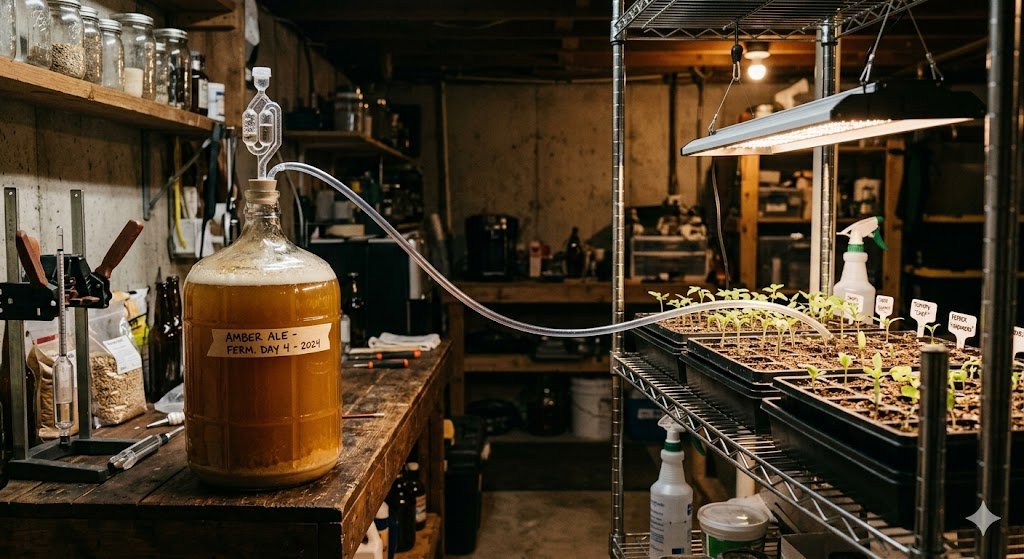
Here’s a quick primer for anyone who hasn’t been around homebrewing: when yeast consumes sugar during fermentation — whether that’s malted barley for beer, honey for mead, or fruit for wine — it produces two things: alcohol and carbon dioxide gas. The CO2 escapes through a little one-way valve on top of the fermentation vessel called an airlock, which lets the gas out while keeping air and contaminants from getting in. You can see and hear it working — a rhythmic bubbling that tells you fermentation is active.
That bubbling is pure CO2. The same molecule, atom for atom, that commercial greenhouse systems deliver through thousands of dollars worth of equipment. Your plants have no way to tell the difference.
The Setup Is Almost Embarrassingly Simple
All that’s needed is a length of flexible aquarium airline tubing — the thin, inexpensive kind sold at any pet store for a dollar or two — and a way to route it from the airlock on the fermentation vessel to the area where your seedlings are growing.
CO2 is heavier than air — about 1.5 times heavier, to be specific. That means it doesn’t float upward and disperse; it sinks. By positioning the end of the tube two or three inches above your plant canopy, the gas flows downward naturally, pooling gently around the leaves where the tiny pores that absorb CO2 are actually located. No pump needed. No fan needed. Gravity does the work.
A standard 5-gallon homebrewing batch produces significantly more CO2 than a seedling tray needs, particularly during the first few days of active fermentation when the yeast is working at peak activity. For a modest indoor setup — a shelving unit, a corner grow space, a few trays under lights — one active fermentation is more than adequate.
The one caveat worth mentioning: this works in a semi-enclosed space. An open room with good airflow will disperse the gas before the plants can benefit from it. A simple barrier — even something as basic as clear plastic sheeting hung loosely around a shelving unit — is enough to hold the CO2 concentration where it needs to be.
What to Expect
A 2017 study out of Wageningen University found fruit yield increases of 23% in tomatoes with CO2 enrichment and no other changes — no extra water, no extra fertilizer, no additional light. Just the carbon the plant was already asking for.
For March seedlings in Pittsburgh, that translates to sturdier starts, better early root development, and plants that hit the ground running when it’s finally time to transplant them outdoors.
The Bigger Picture
This is exactly the kind of double-duty thinking that used to be second nature. Gardeners who also preserved, fermented, brewed, and put things up for winter weren’t operating separate hobbies — they were running an interconnected system where one thing fed another.
The homebrewer’s byproduct feeds the gardener’s seedlings. The gardener’s surplus harvest feeds the homebrewer’s next batch. Nothing wasted, nothing purchased that didn’t need to be, and no $8,000 system required.
It won’t solve every problem your seedlings throw at you this spring. But it’s a free upgrade that costs nothing if the equipment is already in the house — and that’s exactly the kind of idea worth knowing about.
Have you ever tried CO2 enrichment for your indoor starts, or is this the first you’re hearing about it? Drop your questions and experiences in the comments — we’d love to know what’s working in your grow space this spring.